Tuesday, January 29, 2008

At least he's in the National League


He's gone. 93-44, with 1,381 strikeouts in 1,308 innings and a 3.22 ERA, Johan Santana is/was the greatest pitcher in Twins history, and he has been traded to the NY Mets for OF Carlos Gomez and pitchers Deolis Guerra, Phil Humber and Kevin Mulvey.

Let's get this out of the way: It's an underwhelming haul for a two-time Cy Young award winner. If the offers from Boston and New York did indeed include names such as Phil Hughes, Melky Cabrera, Jon Lester, Jacoby Ellsbury and Coco Crisp, then the fact that the Twins ended up settling for a deal from the Mets that didn't even include their top prospect would make it pretty obvious that they held out too long.

Obviously, Bill Smith thought he could pit the Red Sox and Yankees against each other, but he should've known two things:
1 - The Sox didn't really need Santana, so the idea that they were going to clear the shelves of their minor league system for the right to give $130 million to a guy they didn't really need, was misguided. He should've recognized that the first offer(s), while not great, was as good as it would get.
2 - The Yankees definitely could use Santana. Their rotation does not have a true No. 1. Mike Mussina and Andy Pettite are washed up.
But in Joba Chamberlain, Phil Hughes and Ian Kennedy, they have three guys who could be very special. The smart play for the Yanks is to build around those three, using their money vault to fill in the other two spots in the rotation. They sensed this. Smith should've been prepared for that.

Here's another point, though: Santana wanted out, and he wanted out bad. He supposedly set a deadline for a deal for Tuesday. If the Twins didn't get a deal done by Tuesday, he'd report to spring training as a Twin and invoke his no-trade clause during the season.
I have a hunch that the Twins could've offered him $200 million over the next 8 years and he would've turned them down. Some have suggested he's never forgiven the team for keeping him in the bullpen for so long, or that he has never felt like the team has shown a willingness to make moves necessary for a World Series run.
Other reports say he wanted to be on the big stage in New York, and that he wanted to be in a city with a larger Latin American population (side note: Why is it OK for Latin players to say they want to be around more Latin guys? Justin Morneau can't say, 'I signed with the Twins because I wanted to be around other white guys'. Hell, these days even a black guy couldn't get away with saying that. So why is it OK when Omar Minaya and Arte Moreno openly admit to wanting to load their team with Latinos? Seems stupid)
So while many fans will undoubtedly try to blame this one on Carl Pohlad, and bitch about competitive balance and payrolls and etc., I don't think that really had much to do with this. Santana wanted to go. While part of me wants to wish him well in the NL, another part of me says good riddance and hopes he never wins more than 12 games. And wouldn't the Twins chances of getting out of the AL playoffs been slimmer if Santana was pitching for Boston or New York?

*It's bad enough that the Twins didn't land a Phil Hughes or Jacoby Ellsbury, but to make matters worse, they couldn't even get Fernando Martinez out of the Mets. Because Martinez is only 19 he's no sure thing, and there were some indications that the Twins actually preferred Gomez anyway. But it's still disappointing.

*As for the four guys the Twins end up with, they're all pretty good prospects, but they're all the kind of prospects the Twins already had. Mulvey and Humber are middle of the rotation guys, and the Twins probably have 10 guys at least (that's probably being modest), who project to be solid middle of the rotation major league starters. Guerra looks like he could be an ace, but at 19 years old, he's a long ways away and a lot could go wrong (which, incidentally, is what happened with Humber, who was the Mets top prospect before Tommy John surgery, and is now considered a No. 4 or No. 5).

I will say that after spending the entire day reading up on everything I could find about Gomez, I'm more encouraged about him than I was in my earlier review of the Mets prospects. I still think Martinez has more potential, but one thing I didn't really consider - and should've - in evaluating Gomez's somewhat underwhelming minor league stats was that the Mets, by almost all accounts, rushed him through their system too fast.
Gomez split last year between Triple-A in the majors, and while he didn't light it up, he did hold his own. He hit .232 in 58 games for the Mets, and .286 in 36 games in Triple-A. He was 21 at the time.

For a little perspective, consider that when Torii Hunter was 21, he spent the whole year in Double-A and was atrocious, hitting .231/.305/.338.
Gomez may not hit for power, but he will steal bases and he will be an outstanding defensive center fielder. He's supposedly even faster than Mets SS Jose Reyes. He'll just need to work on his on-base skills.
While I hope the Twins send him to Triple-A this year to do just that, I wouldn't be surprised if they make him their opening day CF.
What they should do is sign Kenny Lofton to a 1-year deal to hold the spot down so Gomez can get another year of seasoning.

I'm not thrilled with the deal, but by waiting as long as they did, this was the best they were gonna do. They waited last off-season, when they could've signed Johan and Torii, and now they waited again. And got burned again. At the very least, the Morneau and Michael Cuddyer signings suggest they're finally learning from those mistakes.

It's worth noting that nobody liked the Chuck Knoblauch trade at the time, and it ended up helping to turn the team's fortunes around.
If Gomez and Guerra reach their potential this will end up being a decent, maybe even great trade, and anything added by Mulvey and Humber would just be a bonus.
But there's always the chance it could be a stinker, too.

A losing hand


It's not official, but there are reports surfacing that Johan Santana has been traded to the Mets for OF Carlos Gomez and pitchers Deolis Guerra, Phil Humber and Kevin Mulvey. Fernando Martinez is apparently not part of the deal. Santana will of course have to work out a contract with the Mets for the deal to go through.

Phil Hughes and Melky Cabrera, or Jon Lester, Coco Crisp and Jed Lowrie both seem like much, much better deals to me. If this is true, the Twins overplayed their hand and paid dearly for it.
Of course, if even two of those four prospects turn into quality players, we'll look back at this and laugh.
Here's hoping it happens.

Monday, January 28, 2008

Morneau, Cuddyer sign


Over the weekend Justin Morneau signed a six-year deal for $80 million, the richest contract in Twins history, and Michael Cuddyer signed a 3-year, $23 million deal with an option for a fourth.
I'm tired so I won't go into a lengthy breakdown of the deal, but I'll make a couple points.
*This is good news. By locking up these two, the Twins now have their four best hitters, Morneau, Cuddyer, Delmon Young and Joe Mauer, locked up for the foreseeable future. It sends a positive message to the fans and to the existing players, at a time when public perception of the team was negative and getting worse by the day.
*They overpaid. While Morneau was the driving force behind the team's AL Central title in '06, which garnered him the AL MVP, he's been essentially an average first baseman the rest of his career. Some have used that fact to say that signing him to such a big deal is a mistake, but I am definitely not going there. I think it's a good gamble to expect that Morneau is entering into the prime of his career. Will he hit .321 every year, as he did in '06? Maybe not. But if he hits .275-.300 with over 30 homers each year, my guess is the deal will look like a bargain in a few years, by which time his annual salary of $13 million will probably seem modest.
When you factor in how badly the Twins have struggled to find players like Morneau, this was a deal they had to make.
Cuddyer was actually below average for a RF last year, but giving $8 million a year to a guy who can hit .275 with 20 homers while playing decent defense is OK. He's also one of the most popular players on the Twins, which might have contributed to the team's willingness to pay him. Should something like that matter? Probably not, but I'm OK with it.
Bottom line, sometimes you overpay in the present to avoid really overpaying in the future (which, by the way, is the reason Torii Hunter and Johan Santana are not currently signed to long-term contracts with the Twins).
*The Santana factor
Does this mean the Twins are going to take another run at signing Johan Santana? That's what some are speculating, but my guess is it actually means they're close to a deal. I'd be surprised if the Twins budged from their 4-year, $80 million offer. Then again, maybe they'll decide that they really like what they have and it's worth bending over and paying him. We'll see.

Wednesday, January 23, 2008

Mets?


While no one really totally believes them, the Yankees are saying they’re out of the Johan Santana sweepstakes. And if that’s the case the leverage with the Red Sox is certainly lessened, since many believe they only want Santana to keep him away from the Yanks in the first place. The Yankees kind of need Santana, the Red Sox don’t.
Why would Boston trade Jacoby Ellsbury and Jon Lester when they can probably win the World Series and keep them?
That has led many to speculate that the New York Mets, long considered wannabe outsiders in the Santana dealings, may now be the favorite. The Mets are badly in need of starting pitching, and after last year's collapse at the end of the season, desperate to give the team a shot in the arm. The consensus seems to be that Mets GM Omar Minaya (guy in the suit) will find a way to get it done.
If that’s the case, it presents a good news-bad news scenario for the Twins.
The bad news is that they will not acquire any major league players in a deal with the Mets, they will receive prospects.
And I don’t need to tell you there have of course been several times in trade history when a bundle of prospects acquired in exchange for a proven veteran was unable to produce anything useful. It’s always risky.
The good news is that Santana would be going to the National League where the Twins would never have to see him, save for once every three or four years for interleague play.
The other good news is that while the returns would be disappointing in the short term, there’s a chance the deal could heavily favor the Twins over the long haul.
As of right now, the Mets offer is reportedly outfielder Carlos Gomez (3) and pitchers Deolis Guerra (2), Kevin Mulvey (4)and Phil Humber (7). The numbers in parentheses is their prospect ranking within the organization by Baseball America.
Gomez and Humber appeared in the big leagues in ‘07, so they’d have a chance to help the Twins now, though those two are the lesser of the group. To me, Gomez’s numbers in the minors don’t seem to project anything better than David DeJesus - the good but certainly not great CF for the Royals. Humber looks like another Kyle Lohse - decent strikeout rate, but a 4.11 career ERA in 54 minor-league starts.
Guerra will turn 19 in April and has already made 20 solid starts at the high A level, while Mulvey would probably have a chance to join the Twins rotation now. The ceiling on Guerra and Mulvey could be as a No.1 or No. 2 starter.
Those might be four useful players, but it’s still an underwhelming return for a two-time Cy Young winner, if for no other reason than three of the four are pitchers, and pitching prospects are further from a sure thing than hitters.
The wild card here is a 19-year old outfielder named Fernando Martinez, the Mets undisputed No. 1 prospect. While he’s not currently believed to be part of the Mets offer, the Twins would almost certainly demand him as part of any deal, and the Mets have yet to declare him off limits the way they did with SS Jose Reyes (and the Yanks did with Joba Chamberlain). Strib beat writer LaVelle E. Neal III suggested that Martinez could be in play if the Twins would include a prospect of their own to go to NY with Santana.
Some reports have said the Twins would ask for Martinez to be added to the current deal, with the thinking probably being that Gomez could take over in CF now, while Martinez would be given another year or so in the minors. But if Martinez becomes part of the deal, I say let the Mets keep Gomez. If Gomez is the next David DeJesus, Martinez is the next Carlos Beltran.
So the deal could end up being Santana to the NL (a good thing to be sure), for a top-flight CF prospect, two highly regarded pitching prospects and a third who could also prove useful at the big-league level.
Here’s a closer look at the five Mets propspects being mentioned.

*Fernando Martinez - OF
6-1, 190
Age: 19 Bats: L Throws: R
He signed for $1.4 million at the age of 16 and skipped rookie ball altogether, going straight to Single-A Hagerstown of the South Atlantic League, where he hit .328/.383/.497 in 195 at-bats – at the age of 17. This earned him a call-up to the higher Single-A club in St. Lucie, and while he hit only .193, he did hit 5 homers in 119 at-bats, still at the age of 17. For a 17-year old to be able to hit 10 homers in just over 300 at-bats against Single-A pitching is almost totally unheard of, though he struggled to repeat it in ‘07. He spent last year at Double-A Binghamton, and at age 18, hit .271/.336/.377.Reports say he has the speed to play CF and the arm to play RF.
When he signed at age 16 scouts were making comparisons to Ted Williams, and doing so with a straight face. That’s pretty harsh for such a young kid, but he does appear capable of being a five-tool player. He might be ready for the big leagues by ‘09, but 2010 is probably more likely.

*Carlos Gomez - OF
6-2, 170
Age: 22 Bats: R Throws: R
He spent part of last year with the Mets, and at age 21, hit .232/.288/.304 in 58 games. He spent most of the year in Triple-A, where he hit .286/.363/.414. His minor-league numbers are good but by no means great - .278/.339/.399 in 1,291 at-bats. He does have 141 steals, including 64 in one year. With little power, he’s more of a lead-off type guy (which makes that .339 OBP all the more depressing). His strikeout-walk ratio (250 K’s, 82 walks in 1,291 ABs) is also fairly unimpressive. Gomez seems to me to be one of those guys everyone likes for his athleticism more than his actual performance. I’m just not all that excited about his numbers. Maybe he’ll start hitting.

*Deolis Guerra - RHP
6-5, 200
Age: will be 19 in April
Another guy who skipped rookie ball, Guerra made 17 starts in the Sally League in ‘06 and posted a 2.20 ERA, allowing 59 hits with 64 Ks and 37 walks in 82 innings. Like Martinez, he was 17 when he did this.
Last year, at age 18, he made 20 starts at St. Lucie (high A), posting a 4.01 ERA, allowing 80 hits with 66 Ks and 25 walks in 90 innings. He’s Venezuelan, throws a 95-mph fastball and is working on a changeup. Sound familiar?

*Kevin Mulvey - RHP
6-1, 170
Age: 23 in May
The Mets 2nd round pick in ‘06 out of Villanova, Mulvey made one start before finishing the season with three strong starts at Double-A. That’s where he started in ‘07, going 11-10 with a 3.32 ERA in 26 starts. In 151 innings he allowed 145 hits with 110 Ks and 43 walks. He finished the season with a single start at Triple-A, where he tossed six shutout innings. He has a good fastball and his top secondary pitch is a slider. Is probably very close to being ready now.

*Phil Humber - RHP
6-4, 210
Age: 25
The Mets 1st round pick out of Rice in ‘04, Humber got his first cup of coffee last year. He was the third overall pick in ‘04 and held out for a $3.77 million bonus. That would suggest he’s a future No. 1 (being a 6-4, hard-throwing righty from Nocagdotches, Texas, he was often compared to Ryan, Clemens, Wood, Beckett, etc.), but most scouts currently regard him as a No. 4. That’s probably partially due to the fact he had Tommy John surgery in ‘05. It’s probably also partially due to the fact that he has a 4.11 ERA in 54 career minor-league starts. Still, his 266 K’s in 290 innings is promising.

I think I still like the Yankees and Red Sox offers better, and I think the Twins will still give both of those teams every opportunity to stay in the game. But if they have to turn to the Mets, there's still a chance they can come away with a decent package.
As long as it includes Fernando Martinez.

Friday, January 18, 2008

Morneau, Rincon sign


No, the Twins didn't lock up Justin Morneau to a multi-year deal, but they did agree to a 1-year, $7.4 million contract to avoid arbitration.
Morneau is locked into being a Twin through 2010, so it's not like they were in danger of losing him, but this is still somewhat significant.
Avoiding arbitration is always the better move for the team, because if you go that far, you have to sit in a room and tell an arbitrator why you don't think a player is worth as much as he thinks he is. Considering Morneau and other key Twins are already ornery about the likelihood that they'll play the 2008 season without Torii Hunter, Johan Santana, Carlos Silva and possibly Joe Nathan, it's probably not a good idea to make Morneau any more unhappy.
My guess is they told him something along the lines of, "Hey, we want to get you signed to a long-term deal, but our hands are pretty much tied until the Santana thing gets solved. So for now, here's a nice 1-year offer (he made $4.5 million last year, so he's getting quite a raise), and when we get the Santana thing squared away maybe we can get back to work on a deal for you."
The two sides can continue to negotiate later, and if they strike a deal they can simply agree to tear up the 1-year deal and let a new one kick in.

*As for Juan Rincon, he agreed to a 1-year deal worth $2.475 million.
Yes, he had a bad year last year, but the Twins could be thin in the bully next year. Pat Neshek can't be asked to pitch out of every jam.
It's not a terrible risk, at 2 1/2 million, to try to get Rincon straightened out. Then again, his strikeout rate has decreased each of the last two years. He's apparently been closing in the winter Venezuelan league - hopefully he is able to find the old magic. Because I think fans forget that from 2004-06 he was as dominant and reliable as any setup man in the game.

A Friday update

So I didn't find the time for one-on-one interviews with Ron Gardenhire or Pat Neshek Wednesday, because I was too busy working on a story about poker.
I wish I were kidding. I am not.
I still made the trip to the Twins Caravan, though. The best part was the beer.
Gardy was an impossibly nice guy, taking time to answer any and all questions honestly and thoughtfully, while Neshek seemed extremely uncomfortable.
Everyone wanted to know about Johan Santana, of course, and Gardy said that, if a trade is made, it has to be for players who can help now, because "we're not rebuilding here."
Not yet you're not, Ron.
Side note: Stunningly, he never used the phrase "battle/battled his/their tail off" once. I was ready to keep a running tally and it never happened.
Turning over a new leaf? Doubt it.

*At one point there was a crying baby near the stage, and Gardy said "Someone tell AJ to be quiet." Good one, Gardy.
*While Gardy seems to think the Twins are going to land players who can help now in the Santana sweepstakes, there are some rumblings that the Mets are now the leader, and that would mean full-on rebuilding. All of the prospects mentioned in their package (I'll get to it next week), are either marginal prospects or at least two years away from being ready.
If they accept a deal for five 19-year olds from the Mets when they could've had Melky Cabrera and Phil Hughes from the Yanks, or Jacoby Ellsbury, Jed Lowrie and Justin Masterson from Boston, I'll be pissed.
This thing is almost guaranteed to be ugly for Bill Smith in the short term.

*No progress being made at all in regards to Justin Morneau and an extension. I would advise them to get that done, because he's just getting more expensive by the day.
*Jason Kubel signed a 1 year, $1.3 million deal. Wonder if that means they'll actually play him.
* I think Roger Clemens is guilty as hell, and I'm very much enjoying his public fall from grace. He's always been a piece of shit.
*I hope Randy Moss is not guilty.
*Why is Randy Wittman employed?
*Why can't Spencer Tollackson make a free throw? (Don't care if I spelled that wrong, BTW)
*Why did I get a haircut?

Wednesday, January 16, 2008

Twins Caravan


I'll be at Rookie's Wednesday night for the Twins Caravan, which probably means I'm going to end up interviewing Ron Gardenhire and Pat Neshek.
That might sound cool, but I'm not all that psyched. I'm sure they're going to totally be in the mood to listen to me ask them the same questions that the Twin Cities media has been pelting them with since Christmas.
Anyway, stop by and say hi if you can, otherwise wait for me to weigh in with my uncensored thoughts sometime Thursday.

Monday, January 14, 2008

Fever Pitch: Yay or Gay?

I will admit to being surprised by the negative reaction to my declaration of Fever Pitch as my 5th favorite baseball movie.
I knew nobody liked Jimmy Fallon (I don't either), but, like I said, after putting my dislike for Fallon aside, I liked it. Roger Ebert gave it 3 1/2 stars out of 4, for what that's worth (he also loved Field of Dreams and The Sandlot, and he hated The Natural, so I get the sense he has a handle on baseball movies).
But the number of negative responses, many from people whose opinion I respect (not you Rex), got me thinking.
Maybe I was wrong. Maybe I was blinded by the fact that Fever Pitch was on HBO like every day right before I left on my baseball-themed honeymoon with my wife.
So I popped it in the DVD player this weekend to watch it again, with a critical eye.

Here's the new verdict:
There are some things that are, yeah, pretty gay. Hammy dialog, over the top annoying-ness from Fallon, plot contrivances and whatnot.
Early on in fact, I felt this sinking feeling - Oh, shit, they're right. This is gay.
But eventually the things I liked about it before re-emerged.
Namely, two characters that I could relate to and liked, which probably goes to show just what a great writer Nick Hornby is, since the characters are played by Fallon and Drew Barrymore.

It's a romantic comedy, and if that alone is your reason for hating it, well, check your phony masculinity at the door, Rambo. I'm not impressed. But I'll admit, Fever Pitch works better as a romantic comedy than as a baseball movie (some have said the same thing about Bull Durham, though I wouldn't).

Thing is, there was still a lot of stuff I liked.
I liked the parts where he's teaching the basics of the game to his clueless girlfriend, something we've all done at some point.
I liked how his apartment was like a Sox gift shop. The worst part of being married is that my bitchy wife won't let me do the same thing to our house. I related to that quite strongly.
I liked that the first gift he buys his girlfriend is a Sox warm-up jacket. I also have a habit of buying gifts for women that would be better suited for me. That way if you break up or she doesn't like it - you can keep it!
I liked the part where he gets his season tickets in the mail, and pulls them out of the box in big sheets and smells them. How cool would that be?
I like that he forces his friends to enter a draft to accompany him to games. That seemed sensible to me.
I think a lesser movie would've tried to make Fallon (and, ergo, all die-hard baseball fans) look idiotic, or selfish. But this movie understands and even sympathizes with the guy. It basically says, yeah, this guys' a little weird but there's nothing wrong with that. Sometimes I need that reassurance.
I like that Drew Barrymore doesn't know anything about baseball but tries really hard to learn. A bad movie would've made her uber-bitchy or inserted some lame contrived excuse for her to hate baseball (her dad was killed by a Louisville slugger, or something). But written the way she was, she basically reminded me of every girlfriend and pseudo-girlfriend I've ever had, except my wife.
I like the way the movie takes place over the course of the season, and their relationship mirrors the success of the Red Sox. My mood in the summer often depends on how the Twins are doing, so, again, that made sense.
I liked the scenes in the ballpark. They made me want to be at a game. They make me want to go to Fenway Park. You might think that's a given, that any movie can do that simply by bringing a camera into the ballpark, but Rookie of the Year was filmed at Wrigley Field, and it pretty much made me want to stay as far away from Wrigley Field as possible.
I liked Drew Barrymore's big sister a lot. She's shit-hot. She looks like she could be an American Gladiator. Damn. I even thought it was funny when the fat friend called the gym instructor a Nazi bitch.
The ending is completely outrageous and unbelievable, I'll admit it, but hey, it's a movie. Not a documentary about Red Sox fans (which would be even lamer than it sounds, I'm sure).

I had a conversation once with a serious girlfriend in which I admitted to her that I would never be able to love her as much as I love baseball. I knew that it was the wrong thing to say, but I wanted to be honest. She didn't react as badly as you might think, but, needless to say, we are no longer together. I've never said the same thing to my wife, but I think she's aware of the possibility. I thought of that in the scene where they're fighting and Fallon says, "Name one thing in your life you cared about 23 years ago that you still do! 10 years! 5!"
Further evidence, of course, that men are better than women.

In hindsight, Fever Pitch is not better than the vastly overrated but still good Bull Durham. So I'd probably switch those two on my list. But otherwise, I'm sticking by it.
And you can all kiss my gay ass.

Thursday, January 10, 2008

My 10 Favorite baseball flicks

A couple weeks ago I blogged the best baseball books I've read (though I probably forgot a few to be honest). So now, with nothing happening with the Twins (will they really go to spring training with Johan Santana still in the fold?), we might as well cover the best baseball movies.
Movies are a little bit of a different animal. Many of them, perhaps most of them, are bad. Not that I haven't read some bad baseball books (Slouching Toward Fargo by Neal Karlen comes to mind), but I think movies don't try as hard to be good because they know stupid people will fork over their $8 to see bad baseball movies, something your average Joe won't do for a book.
(Football is worse, though. Almost every football movie is terrible. They create a bunch of cookie-cutter characters and make them hit each other, get some cheerleaders and a loud, obnoxious soundtrack, and, well, that's usually about it. Baseball movies aren't quite so formulaic - most of the time)

As a kid I can remember every time I saw a trailer for a sports movie on TV I immediately wanted to see it, and as a dumb kid, usually enjoyed them. As an adult, I almost never get excited about sports movies. I generally try to stay away from them, because they're usually lame. But there have been some very good ones.
This is my list, but I should stress that as I am no movie critic, I'm not calling these "the greatest baseball movies ever", but rather, my own personal favorites. Here's my top 10, starting at No. 10.

10. Soul of the Game
A made for TV (don't worry, HBO, not CBS) film set in 1944, after the death of segregationalist commissioner Kenesaw Mountain Landis. With Landis' death, Negro League All-Stars Satchel Paige (Delroy Lindo), Josh Gibson (Mykelti Williamson - aka Bubba Gump) and Jackie Robinson (Blair Underwood) all sense that integration of the major leagues may be around the corner. Branch Rickey is indeed looking to break the color barrier for his Brooklyn Dodgers, but while Gibson and Paige both assume it will be one of them, if not both at the same time, Rickey is eyeing the unassuming, educated and soft-spoken Robinson.
While there's plenty of good baseball scenes, the movie is carried by Lindo's portrayal of the flamboyant Paige. The movie doesn't turn the black players into saints, instead showing them as human beings with just as many flaws as their white counterparts. The final scene, with a Negro League All-Star team preparing to take on a team of big leaguers, with racial tension scorching the field, is just about heartbreaking.

9. *61
Ostensibly about the homerun chase of 1961, this movie is really almost a bio-pic of Roger Maris, one of the most unfortunate souls baseball has ever known.
Barry Pepper not only looks just like him, he plays Maris as the tortured, nervous and uncomfortable person he supposedly was. Director, Yankee fan and tool Billy Crystal, surprisingly, keeps his hero worship mostly in check (though there is a useless scene where a fat italian guy that's supposed to be Yogi Berra appears at batting practice and recites a bunch of Yogi-isms in a forced and distracting manner). I liked the way the movie looked, from the uniforms to the stadiums, to the way they held and swung the bats (but what was with the helmets that looked like they were made of felt?).
By the end of this one you're really pulling for Maris, and feel bad that his record was broken by a bunch of roid-heads.

8. The Rookie
Based on the true story of Jim Morris, the 38-year old science teacher who basically made the Tampa Bay Devil Rays as a walk-on, the Rookie is so perfect as an inspirational fairy tale that it would probably be considered lame, cliched and contrived if it weren't true.
Dennis Quaid is barely passable as a pitcher (you can tell he worked so hard to make his delivery believable that it has an almost robotic feel to it), but he's great as a good-natured coach, teacher and dad, the kind of guy you would want to pull off something like this. It mosies along pleasantly enough for most of the way, but from the part where he gets called up to when he makes his Major League debut it's almost perfect, venturing into tear-jerker territory at almost every moment.

7. A League of Their Own
The fact that Tom Hanks has won I don't know how many Oscars and none of them were for his portrayal of "Jimmy Dugan" (based on the real-life Jimmy Foxx), doesn't seem right to me.
A League of Their Own is an important historical piece, because I don't think most people even knew the All-American Girls Professional Baseball League existed until it was made.
It's easy to pull for the girls in the movie, and they are all believable as ballplayers. The World Series ending is very well-done, partly because unlike a lot of sports movies, you really don't quite know how it will end. But the reason it's a great movie is how well it shows that baseball is something you fall in love with and don't let go of, and that that is something that has nothing to do with whether you're a man or a woman. Hanks' character begins the film hating the idea of women playing ball, but by the end he's neck-deep in it because he's realized it's not about the girls, it's about the game.
A League of Their Own would be higher on my list if it weren't for the horrible little-sister character, horribly played by Lori Petty, which occasionally threatens to ruin the film, and also makes the climax a little disappointing. But Hanks' performance is one of the greatest in baseball movie history.
The speech he gives Geena Davis when she tries to quit the team is mesmerizing, the speech he gives in the clubhouse before the big game is funny and touching, and his cut-off man lecture to the rightfielder (the second one) is an all-time classic.
Still my favorite part is when Geena Davis tells him right before the big game, "Jimmy don't you ever shave, you look like shit," causing him to turn around and say to himself under his breath, "We're gonna win!" Pure gold.

6. Bull Durham
Maybe the most overrated sports movie in history, but it's still pretty good, which is why it makes the list.
Overrated because some of the stuff in here is just plain stupid. Like Tim Robbins. He's terrible as a pitcher, and I didn't think his portrayal of the dumb, wet-behind-the-ears rookie was really all that convincing, either. There are some issues that stretch the film's credibility, too, like Nuke getting called up from A-ball to the majors (not impossible but extremely rare), a late-30s catcher accepting a demotion to A-ball (no team would even bother to try), and the scene behind the bar when Crash (Kevin Costner) pulls a baseball out of his jacket and Nuke can't hit him with it from literally three feet away. That scene is an embarrassment. Crash's "kisses that last three days" speech is also extremely contrived and lame.
And while I really like the Susan Sarandon character, the parts where she acts as a pitching coach to Nuke and a hitting coach to Crash are ridiculous and unnecessary.
Still, there's an awful lot the movie gets right, making it nearly impossible for any ex-player not to enjoy it.
The obvious highlights are when Crash tells the hitter what's coming when Nuke shakes him off (especially the second such instance), the "cocksucker" argument with the umpire, the fight over song lyrics on the bus, and Trey Wilson's "lollygagger" tantrum in the lockerroom. But there are less-obvious moments that the movie gets right, too, like when Crash shows up in Durham, announces he's quitting, then turns around and asks what time the next day's game starts. Or the scene when Wilson has to cut a struggling player, and the scene when Crash apologizes for a drunken tantrum he directed towards Nuke the night before.
Bull Durham is not the greatest baseball movie ever made, and certainly not the best sports movie ever made, as Sports Illustrated declared it a few years ago. But it's up there.

5. Fever Pitch
It's a credit to a movie that it can star Jimmy Fallon and Drew Barrymore and still be not-horrible, let alone as good as this one is. In fact, I didn't really like Fever Pitch all that much the first time I saw it, because I didn't give it a chance. Any movie with Jimmy Fallon, I reasoned, couldn't possibly be watchable. But in the same way SLC Punk not only overcomes the presence of Matthew Lillard but is actually strengthened by it, Fever Pitch probably wouldn't work with someone else in the lead role.
In recent years I've come to absolutely hate the Red Sox, largely because of oversaturation and a sudden rash of phony "Sawx" fans, and I still love this movie. While it perfectly nails what it's like to be a diehard fan, it does an even better job, I think, of capturing the anticipation for opening day. The agony of waiting through winter, counting down the days, and the magic of finally making the walk to the ballpark, of emerging from the concourse to see that ocean of green on a crisp April day.
I also like how the movie paints Fallon's character as an extremist without mocking him or turning him into a bad guy. It understands people like him (and me). And the Berrymore character is well-written. She doesn't really get the fascination with baseball, but she genuinely tries to. This movie could be a good "how-to" manual for a couple in a similar predicament. And it's also very funny. It's kind of like High Fidelity, which isn't surprising since both are
based on books written by Nick Hornby.

4. The Bad News Bears
More than likely we've all been on a Little League team that had a lot of these same kids on it. Walter Matthau is definitely hilarious as the liquored-up coach, but the kids are the best part. I've known a lot of kids like Kelly Leak, and the fat kid, and the pottymouth kid, and so on. It also works as a sort of social commentary on how carried away adults can get with youth sports. The scene where the kid refuses to pitch for his crazy dad in the big game is a reminder that usually kids are more interested in having fun than winning. Certainly Bad News Bears is not politically correct (which is why the recent remake starring Billy Bob Thornton wasn't quite as good), but watching it today that just makes it funnier.

3. The Sandlot
In a lot of ways, The Sandlot is similar to The Bad News Bears, because it's another example of how much better baseball is for kids when adults aren't involved. They usually just get in the way, and this movie reminds you how much better it is when the kids can just be kids, and go play without having to worry about rules or wins and losses. The Sandlot is set in the 1960s, but it just as well could've been set at Linwood Park on Walker Way in Sioux Falls, circa 1990. As much fun as I had in Little League all the way up through Legion ball, the most fun we usually had as kids was getting a game together at the Park (if we were really lucky we could go 5 on 5 or 6 on 6), with no uniforms, no coaches, no umpires, just a bunch of kids spitting, swearing, sliding and fighting all day long, nearly every day.
The Sandlot is sort of a PG version of that. It's just a movie about what it's like to be a kid in the summer. You play ball, you go swimming, you have sleepovers - over and over.

2. Field of Dreams
A common theme among all the great baseball movies, and pretty much every one on this list, is the examination of baseball's role in the lives of those who love it. It's not just a game to those people, it's a significant part of who they are. Something that has shaped them, and that they can always go back to now matter how far they may have strayed from it.
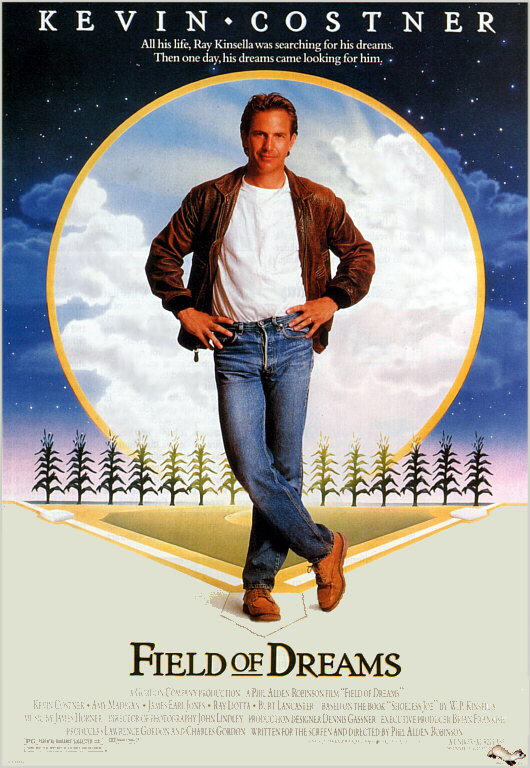
Field of Dreams of course, takes this idea to an extreme. There are hardly any baseball action scenes in the movie, no "big games", and yet it has still managed to become almost the quintiessential "baseball movie".
You know the story. Kevin Costner builds the field and he doesn't know why he's doing it, but he comes to discover that baseball was the one common bond between him and his father, and it helps him rediscover himself and reconcile with his estranged (actually dead) father. Along the way he helps two strangers - a bitter, aging writer and a doctor who played an inning in the Majors but never got to bat - remember what the game meant to them, too.
I've read a lot of reviews of Field of Dreams that ripped it for being ridiculous, corny, sappy, etc., and while I can kind of understand how someone might react that way, I think that almost proves why the movie is so great.
If you look at it critically, Field of Dreams is sappy and ridiculous.
But that's sort of the point. Those who really love the game love it so much that they don't even question Field of Dreams. It's almost perfect.

1. Major League
Movie critics have never really given Major League much due. When it was released in 1989, it probably (and perhaps rightfully) seemed like a Bull Durham rip-off (aging catcher, goofy rookie pitcher, sexy and smart girlfriend).
But Major League improves on a lot of Bull Durham's mistakes (which, not coincidentally, were mostly baseball-specific things that your average movie critic probably didn't catch), and it also looks at the game from a bigger scope (Majors as opposed to minors).
The early scenes in which the film establishes the plot (the owner wants to tank the season to move to Miami), are often hilarious ("This guy here's dead!" "Cross him off then.")
But any baseball fan will be immediately hooked by the movie's realism. The spring training scenes are great, and establish right away that the filmmakers know how a Major League team is put together, and what the months of March through May are like for fans, players and the manager.
The in-game action scenes are the best of any baseball movie ever. Charlie Sheen was supposedly a good high school pitcher and it shows. Not only is he the best baseball-playing actor we've probably ever seen, his acting is also better than Tim Robbins' was in Bull Durham. Tom Berenger, Corbin Bernsen, Dennis Haysbert and Wesley Snipes (among others) also give true-to-life performances, while James Gammon is practically Oscar-worthy as manager Lou Brown. Bob Uecker is essentially playing himself as the radio guy, but that's certainly not a bad thing.
One could argue that the authenticity of the baseball scenes is less important than how well the movie is written, acted, directed and so on, but I think that misses the point. The actors are so believable that you begin to feel like you're watching and following a real team, and you begin rooting for them. As the Indians heat up and start winning you become a fan, and the movie does a perfect job of capturing the way in which a winning baseball team can take over an entire city. The scenes in the bar where the punk rockers are hugging the construction workers aren't just funny, they're true-to-life.
Many sports movies end with "The Big Game", and a lot of times that ruins them. But watching the final couple innings of the big game in Major League is almost like the real thing because it is so well done. The stadium is full and rocking, the players are on the edge of the dugout, the radio guy is standing up in the booth, and even though you know its a movie you're on the edge of your seat and your heart is pounding.
Then comes the most perfect ending ever.
Wesley Snipes comes charging around third with Uecker's voice-over, "Hayes around third, he's gonna try to score!"
The throw comes home from first, but Snipes executes a perfect hook slide. Faintly, you can hear Uecker saying, "He issss....", and the camera switches to a close up on the umpires face, and he screams, "Safe! Safe!", and we cut back to Uecker, who jumps out of his chair and screams, in the best line in baseball movie history "And the Indians win it! The Indians win it! Oh my God the Indians win it!"
That's the last line in the movie, but we still get another five minutes of celebration scenes, which, again, are perfectly executed. The fans rushing on the field, not sure what to do but just wanting to be a part of it, while the players hug everyone they can get their hands on.

A couple years ago I was working on a column about the best baseball movies that was to run in the paper, but it ultimately got cut when we realized it would be as long as the blog entry I'm doing right now.
But before that decision was made I went down to the Canaries clubhouse one day and went around the clubhouse, asking every player to name his favorite baseball film. Major League was an almost unanimous choice. And I specifically remember what Chad Hermansen, a former Major Leaguer said, because it was going to be the best quote of the story I was working on.
"Anyone who would say anything besides Major League," Hermansen said, "probably doesn't know baseball all that well."

Monday, January 07, 2008

Put him in the goddamn Hall


Major League Baseball will induct another Hall of Fame class this week, and almost certainly, Bert Blyleven will once again be left out.

The closest the Twins TV color man and 22-year veteran has come to the required 75 percent of the vote was in 2006, when he got 53.3 percent. That dropped last year to 47.7 percent.
I set out to compile a definitive report on why Blyleven should be a Hall of Famer, and when i did so, I began armed with mostly peripheral information: Lots of strikeouts, a good ERA, two World Series rings, and maybe the most legendary curveball in history.

The more research I did, however, the more clear it became and the angrier I got. It's a joke (or a travesty, depending on how serious you take this stuff) that Blyleven isn't in. In fact, he's exhibit A for the argument that too many of the sportswriters and other media covering this game are still clinging to prehistoric notions, and that the traditional methods used by the mainstream media to judge players' worth are far outdated.
These are the typical arguments for why Bert doesn't belong:

He didn't reach 300 wins (the arbitrary "magic number" made up by sportswriters in the middle part of the 20th century).
He was only 37 games over .500 (287-250).
He's 10th all-time in losses.
He only won 20 games once.
He never won a Cy Young award.
He only made two All-Star games.

Notice most of these excuses revolve around wins and losses. Writers love to smugly say things like, "It's not the Hall of Very Good", and then point to Bert's winning percentage.
This is stupid to the Nth degree. If you ever hear someone say something like this on TV, never listen to anything they say ever again.

Teams win games. Hitting, fielding, relief pitching, weather and ballpark dimensions all play a part in who wins the game. So judging a pitcher on just W's is obviously pointless when so many other outside factors are involved.
In 2007 for example, Johan Santana pitched 219 innings, struck out 235 batters, walked 52 and had a 3.33 ERA. Tim Wakefield pitched 189 innings, struck out 110, walked 64 and had a 4.76 ERA. Anyone with a clue would say Santana was the far better pitcher.
Does the fact that Santana went 15-13 and Wakefield went 17-12 change that fact? No, of course not. And I should mention that while yes, Blyleven is 10th all-time in losses, eight of the nine guys ahead of him are in the Hall, including Cy Young, Nolan Ryan, Walter Johnson and admitted cheater Gaylord Perry.
As for the lack of Cy Young's, that's an equally bad argument, because Cy Young's are voted on by the same idiots who vote for the Hall of Fame, and therefore tend to put way too much emphasis on team success and win-loss record.
All-Star appearances are just as meaningless, as they are largely popularity contests. Joe Torre once put a struggling Javier Vazquez on the AL all-star team in an attempt to boost his confidence.

Clearly all the excuses are bunk, but there are also plenty of overwhelming reasons why Bert does belong.
We always hear about "the ring" when players' greatness is in question. Bert has two, and he played a big part both times. In 10 career playoff appearances, Blyleven has a 2.47 ERA, and yes, a 5-1 record. By comparison, Whitey Ford, regarded as one of the greatest post-season pitchers ever, went 10-8 with a 2.71 ERA in his playoff career. Funny how that never comes up.

Blyleven was a horse, working 4,970 innings in 685 starts, 242 of which he completed.
Some have argued he simply pitched for a long time, but he wasn't just prolific, he was effective. His 3.31 career ERA passes for some good pitchers' best season. From 1970-1987, he failed to post a better than league-average ERA only once. He finished in the top 10 of the league in ERA 10 times, top five in the league in strikeouts 13 times. His 60 career shutouts are ninth most all-time. He won 15 1-0 games. For his career, Blyleven's ERA was 0.5 runs lower than the league average, the 19th biggest differential in history. And yes, everyone else in the top 20 on that list is in the Hall.

I could go on about how Bert was also regarded as a strong fielder of his position, was extremely popular with teammates and fans, and earned a reputation as one of the game's great pranksters, but then I'd just be like all the voters who will go to any length to find some stupid reason to vote (or not vote) for someone. The important numbers speak for themselves.
Bert was one of the greatest pitchers of his generation. A reliable ace whose 90-mph fastball and legendary curveball gave hitters fits. A workhorse who almost always pitched into the 8th or 9th inning, and who dominated in post-season play.
"He was as good as there was for a long time," Hall of Famer George Brett said recently. "Bert is up there with the toughest four or five guys I faced in my career. The writers never had to face him. If they did, they'd vote for him."

Thursday, January 03, 2008

Go Patriots. Seriously, Go Patriots


I am so pulling for the New England Patriots to go 19-0.
Not because I'm protesting the Vikings, or because I'm a fair-weather fan.
And not because of Randy Moss (though I'm happy to see him sticking it to the rest of the NFL).

No, I'm pulling for the Pats for one reason: The 1972 Miami Dolphins.

Don Shula. Bob Griese. Earl Morrall. Larry Csonka. Jim Kiick. Mercury Morris. Nick Boner-conti. Jim Langer. A bunch of other mostly white douche-bags.

What the Dolphins did in '72 is of course, impressive, because no one else has ever done it. But I'm just tired of hearing about them. Most experts say the '73 Dolphins, who lost twice, were actually a better team.
Yeah, the Dolphins went undefeated, but they didn't play a winning team in the regular season. They entered the Super Bowl against the Redskins with a 13-0 record and were actually the underdogs. They won 14-7.
Morrall and Griese combined to pass for 2,000 yards and 17 TDs with 12 INT that year.
Tom Brady has thrown for 4,000 yards, 50 TD and 8 INT.
The Patriots played the No. 2 seed in the AFC (13-3 Indianapolis) and the No. 1 seed in the NFC (13-3 Dallas) and beat them both.
They set all kinds of records. They're better. It's not close.

Meanwhile Mercury Morris is going on ESPN rapping about how the Patriots accomplishments will never surpass what the Dolphins did.
Someone tell Mercury McCokeHead to shut the fuck up. He's embarrassing.

Comparing teams from different eras doesn't make a lot of sense, and it's not the Dolphins fault that the league was weaker 35 years ago, but let's face it.
The worst team in today's NFL (which, ironically, is the Dolphins) would hammer the '72 team. There are no white guys rushing for 1,000 yards today, no offensive linemen who weigh 245-pounds.
Larry Csonka wouldn't have played D1 college in the modern era, let alone been an NFL Hall of Famer.

The Pats are the most dominant team ever. They'd beat the '72 Dolphins by a hundred. And if they can close the deal, we'll never have to hear from Morris, Shula or Boner-Conti ever again.
That would be a good thing.

Wednesday, December 26, 2007

Merry Xmas and stuff


So I guess you know you're getting old when you start getting books for Christmas instead of video games.
I have a lot of reading to do.
Now on my to-do list are The Bad Guys Won by Jeff Pearlman and 3 Nights in August by Buzz Bissinger. Apparently three more books are on the way via UPS according to my wife, and while one of them is undoubtedly The Replacements: All Over But the Shouting - about the greatest American rock band of all time, I'm assuming the other two are probably going to be about baseball.

And in perhaps a further sign that I'm getting old, I'm actually looking forward to reading all of them. I recently finished The Cheaters Guide to Baseball by ussmariner blogger Derek Zumsteg, and it kind of reinvigorated my appetite for good baseball reading.

Reading about baseball (and other stuff) as a kid not only primed me for my present career as a sports writer, but it also probably kept me from either dropping out of or flunking out of high school.
High school was impossibly stupid, the most pointless thing that ever happened to me, but going to class gave me a time and a place to get a lot of reading done. I read four John Irving novels and a few baseball books in my junior year alone, and I didn't do any of it at home during my free time. That's what makes it harder to read as an adult. To do it, I'd actually have to give up some of my own free time. But I'm willing. I'll get started tomorrow.

I'm assuming if you take the time to read this blog, that means you're literate enough to have read a book cover to cover before, and enjoy baseball to some degree, so while I'm on the subject, here are some of the baseball books I've enjoyed best.

*I Love This Game - Kirby Puckett
Puck's autobiography is extremely light weight, and if you aren't a Twins fans or didn't follow his career somewhat closely, you might not have much reason to read it. But it's a fast-moving story that covers Kirby's entire life in pretty good detail. I particularly enjoyed the parts about Kirby's flirtation with leaving the Twins to sign with the Red Sox in the early 90's. He was candid about the situation and it gave a telling glimpse into how the Pohlad's operate.
The books strength is in how it lets Puckett's shiny disposition come to life. Puckett's ex-wife, Tonya, and others made efforts to portray Kirby's "lovable" side as a bogus alter-ego in the later stages of his life, and it's pretty clear that he did have a dark side. But anyone who reads this book will come away confident that he was a great ambassador of the game, a great teammate, and someone who truly did care a great deal about the fans.

*The Mick - Mickey Mantle
Great because Mick pulls no punches. If memory serves (I read it several years ago) he doesn't talk much about his womanizing, and the controversial liver transplant didn't take place until later, but he's otherwise pretty unflinching in his battles with excessive drinking and partying. His story of rising from the Oklahoma farm to the Yankees is inspiring, but the highlights are certainly his late night shenanigans with Billy Martin, many of which had me laughing out loud. The second funniest baseball book I ever read.

*I Ain't an Athlete, Lady - John Kruk
The funniest baseball book I ever read. Written well before Kruk became a terrible ESPN analyst, this book was the reason I knew Kruk was a terrible choice for an analyst the day he was hired. He's anti-intellectual. A Big Mac-and-beer type of guy who never took two seconds to analyze himself, much less the hows and whys of MLB.
It makes for a bad analyst but a terrifically entertaining storyteller. Kruk tells stories about living with a rowdy family, playing with rowdy teammates, and the humorous, aw-shucks demeanor that overshadowed what a great player he was throughout his career is ever-present , but the highlights are without a doubt the stories of the '93 Phillies team and his days playing for Larry Bowa. If you read this book, you'll never look at Bowa - currently a Yankee coach and formerly an ESPN analyst himself - the same way again.

*The Cheaters Guide to Baseball - Derek Zumsteg
Both funny and enlightening, the Mariner blogger does a terrific job of covering the history of cheating in baseball from the dirty play and gambling scandals of the 1800s to the steroid scandals of today. Spectacularly researched, yet it's more than a history, it also does a great job of pointing out (and celebrating) the fine line in baseball between what is considered cheating (steroids, corked bats) and what is considered gamesmanship (stealing signs, lying to umpires). The chapter on the ways a groundskeeper and his crew can affect a game is fascinating.

*Season of Dreams - Tom Kelly with Ted Robinson
Robinson was the Dick Bremer for the '91 Twins, and he does a terrific job of taking Tom Kelly's retelling of the season and putting it in proper context and actually building suspense in a non-fiction book. For anyone who remembers the '91 season as vividly as I do, it's an absolute must-read. From the 2-9 start to the 15-game winning streak to the playoff push, reading it again recently was like looking through a high school yearbook. Loved it.

*Throwin' Heat - Nolan Ryan
Reading this one you can actually hear Nolan's deep, twangy Texas drawl as he recounts an amazing career that spanned parts of four decades. Not just a bunch of stories from his career, but a look into his thought processes on the mound, and how tough it was for a conservative farm boy from Texas to deal with immense celebrity and be a family man at the same time.

*The 20th Century Baseball Chronicle - David Nemec
If there was a class on baseball history (I'm sure there is somewhere) this would be the textbook. Weighing in at five pounds and over 600 full-color pages, it's chock full of stories, photos, stats and figures from each year from 1900-1991.
I learned more about baseball history from this book than any other source ever.

*Hi Everybody - Herb Carneal
If you didn't spend a large number of your summer days and nights with Herb's smooth and steady voice keeping you company while working on the mower in the garage, or relaxing by the lake, or making a long drive, this book won't appeal to you. But if Herb was a big part of your life, and if you visit this blog regularly he probably was, you'll enjoy it. It's like spending a few hours in the cheap seats with your Grandpa.

*Summer of '49 - David Halberstam
So good I've read it three times.
Meticulously researched and beautifully written, one of the greatest American writers set out to create a historical account of one of baseball's greatest pennant races and he wound up writing a novel. Seriously, it's nearly impossible for a non-fiction book to be so totally engrossing.
You don't have to be old enough to remember that season, and you don't have to be a Red Sox or Yankees fan (much of the story focuses on those two). In fact, you wouldn't even have to be a baseball fan to enjoy this book.
I was born in 1980, and I feel like I know exactly what baseball, and America's relationship with it, was like in 1949.

Wednesday, December 19, 2007

To contend or not to contend?


I'm starting to think that if the Twins were to keep Johan Santana and Joe Nathan for the 2008 season, they might be able to contend for a playoff spot.
If they didn't trade Johan of course, that would mean they didn't acquire Jacoby Ellsbury or Melky Cabrera. So I'm guessing they'd sign Kenny Lofton to play CF.
So this would be the likely roster.

CF Kenny Lofton
2B Brendan Harris
C Joe Mauer
RF Michael Cuddyer
1B Justin Morneau
LF Delmon Young
DH Jason Kubel
3B Mike Lamb
SS Adam Everett

Bench
Mike Redmond
Craig Monroe
Nick Punto
Jason Pridie
(Alexi Casilla - if they only keep 11 pitchers)

Rotation
Johan Santana
Francisco Liriano
Scott Baker
Boof Bonser
Kevin Slowey

Bullpen
Matt Guerrier
Juan Rincon
Pat Neshek
Dennys Reyes
Jesse Crain
(Glen Perkins - if they keep 12 pitchers)
Joe Nathan

There are a lot of question marks, obviously, like Liriano's health, Boof's weight and conditioning, Rincon's ability to bounce back, Lamb and Harris playing every day in the IF; but if things go right like they did in 2006, this team would be good enough to contend (though if Detroit plays up to its talent we're probably talking wild card).

If they trade Santana they probably get either Phil Hughes or Jon Lester in return, and while both of those guys are ready to be quality big leaguers right now, they're not ready to be aces - yet. Baker would become the "veteran" of the staff.

And if Santana is traded than you have to trade Nathan next. He's in the last year of his contract, and when you consider the washed-up Eric Gagne just got a $10 million, 1-year deal, it's safe to say Joey will be way out of the Twins price range next off-season (and even if they could afford it I wouldn't do it. Smart teams don't pay $10-$15 million a year for a closer. They also don't pay $11 million a year for Carlos Silva, which the Mariners are about to do.)

I'm still about 90% sure the Twins are going to trade Johan. Although I've also said that I'd be willing to let him walk after this year for a World Series ring. Could they do it? It'd be a big longshot, and it'd be the risk of all risks to try.
What if they kept him, went 93-69 but still missed the playoffs? At that point you lost out on a chance to get Hughes or Ellsbury, lose Johan for nothing, and don't go to the postseason. That'd be tough to swallow.

There have been reports that Santana wants a 7-year contract, and that would be a risky thing for the Yankees or Red Sox, let alone the Twins. But a 5-year, $120 deal might not be as ridiculous as it sounds.

Think about it.

Right now it seems like suicide for the Twins to commit such a large chunk of their payroll to one player. But look at how quickly the market inflates each year. Last year, the whole world thought Royals GM Dayton Moore was insane for giving Gil Meche a 5-year, $55 million deal. Now it seems like a decent investment, and Silva - a lesser pitcher - is getting the same deal and no one bats an eye.

By 2010 the going rate for an ace could be $35 million a year. If they signed Santana now for $20-$25 million per, it'd probably be a bargain in a few years. While the Twins do work on a budget, they're not as "small market" as the front-office staff likes you to believe. The payroll will probably be over $100 million by 2009.

To be clear, I'm just sort of kicking some thoughts around. I still expect Santana to be traded. I just wonder what exactly the team will be looking to accomplish in 2008 if and when they do.

Monday, December 17, 2007

An actual infield


Last year the Twins infield consisted of Justin Morneau, Luis Castillo, Jason Bartlett and Nick Punto when the season began. All four were coming off excellent seasons.
But Punto predictably went back to hitting like a utility infielder, Bartlett saw his offensive production drop considerably, and Castillo's primary skills (hitting for a good average and getting on base at a decent clip) were minimized by the failures of the rest of the lineup, and he was traded as the Twins fell out of the race.
That left the Twins with some work to do this off-season.
They included Bartlett in a trade with Tampa Bay to acquire OF Delmon Young and the strong-hitting, average-fieldeing Brendan Harris, and this weekend signed the left side of the Houston Astros 2006 IF; SS Adam Everett (1 year, $2.8 million) and 3B Mike Lamb (2 years, $6.6 million with a team option for 2010).

When Everett signed, I wrote that while his fielding is regarded as being superb, he was a lesser total package than Bartlett. That may prove to be the case, but in looking at the big picture, his signing makes a little more sense and starts to look a little better.
Harris has limited range at 2B, and Lamb is regarded as a well-below average defender. He played a lot of 1B in Houston, and other teams looking to sign him apparently pictured him as a DH/1B.
But Everett, who some defensive studies have proclaimed to be the premier defensive player of the current era, can certainly lessen the effects of Harris and Lamb's shortcomings, especially Lamb's.
What the Twins have essentially done is give themselves an infield that consists of three above average hitters, who are good (Morneau), average (Harris) and poor (Lamb) defensively, and one guy who is a terrible hitter and a world class defender, and that guy is playing the most important position.

3B is at the moment one of the weakest positions in baseball. After A-Rod and Mike Lowell re-upped with the Yanks and Sox, Lamb was probably the best 3B available. Seriously.
Lamb has never had more than 381 ABs in a season, and he's been playing in an extreme hitter friendly ballpark, but his career line of .281/.339/.427 is obviously much, much better than Punto, or Luis Rodriguez, Tony Batista, etc. In the last two years in particular, Lamb, who is 32 and lefthanded, has been very good at the plate.
In '06 he hit .307/.361/.475, and last year he hit .289/.366/.453.
He'll struggle defensively and he might not quite reproduce those numbers in the AL, but even a .270/.330/.440 line would make him a huge, huge upgrade at 3B.
The other good news is the move means Craig Monroe will not be an everyday player. The Twins lineup is almost set, and it actually looks pretty good (nowhere near as good as Detroit's obviously, but possibly as good as the one that won 96 games in 2006).

CF Jacoby Ellsbury/Melky Cabrera (still assuming Johan's gonna go)
2B Brendan Harris
C Joe Mauer
RF Michael Cuddyer
1B Justin Morneau
LF Delmon Young
DH Jason Kubel
3B Mike Lamb
SS Adam Everett

The 1 thru 8 spots will all be above league average, and several of them could be considerably better than that.

One thing seems kind of weird, though. Neither Everett or Young, or Monroe, are particularly young, so they would seem to be added with the goal of competing in 2008. If the Twins trade Santana, they won't have the pitching to compete. If they kept him, and Francisco Liriano actually came back strong, they suddenly might be good enough to have a shot at the playoffs in '08.
I just wonder what exactly the goal is. They won't be bad next year, even if they do trade Johan (and by the way, the trade of Dan Haren to the Diamondbacks significantly helps the Twins leverage, and the Yanks have confirmed they're still in the hunt).
But if they move Johan with an eye to the future, will Everett and Lamb be a part of it?

Either way, it's very encouraging that Bill Smith is giving his manager quality parts with which to build a lineup, rather than taking ill-advised fliers on washed up veterans, or asking too much of overmatched players.

Thursday, December 13, 2007

Twins sign Everett....Mitchell report


The Twins have signed SS Adam Everett, who became expendable from the Houston Astros one day after they landed Miguel Tejada in a six-player trade.

Here's the lowdown on Everett. Defensively he is very, very good. And, unlike guys like Nick Punto and Juan Castro, his terrific defensive reputation is real - based on actual metrics such as zone rating and range factor - not just a made-up reputation built off a couple of highlight plays that showed up on Sportscenter. Jason Bartlett was a very good shortstop, Everett is better. In fact, many regard him as the absolute, No. 1 best defensive shortstop in baseball. That will be beneficial to a young pitching staff.

That's the good news. Here's the bad. He can't hit.
For his career, he's hit .248/.299/.357 in 2,145 at-bats. That's near identical to Punto's .245/.314/.321 career line. Everett has a little more power - he hit 11 homers in 2005 - but he won't draw near as many walks as Punto can.
'05 was Everett's best year, as he hit .248/.290/.364 with 11 homers, 54 RBI, 28 doubles and 21 steals. But in the last two years he's posted Punto-ish OPS+'s of 64 and 56.
In an injury-plagued '07 he hit .232/.281/.318. You thought Punto's '07 season was historically bad (it was) - he had a 52 OPS+, just 4 points lower than Everett's.
The gain in defense from replacing Bartlett with Everett is not enough to negate the loss in offense in my opinion. Factor in that Everett is two years older than Bartlett, and it's clear that Bartlett is the better total package, a factor that deals another blow to the earlier trade with Tampa that sent Bartlett to the Rays.
I do get the feeling that this could be another sign the Twins are strongly considering moving Michael Cuddyer back to 3B. While you can get away with having a good-field, no-hit shortstop such as Punto or Everett in the lineup, you can't do it with another banjo-hitter at 3rd, and there aren't a lot of options out there for a starting 3B. If the Twins do move Cuddy back to the hot corner, the Twins lineup probably looks like this.

CF Ellsbury/Crisp/Melky
2B Brendan Harris
C Joe Mauer
3B Michael Cuddyer
1B Justin Morneau
RF Delmon Young
LF Jason Kubel
DH Craig Monroe
SS Adam Everett

That certainly looks better than last year's lineup, but the obvious problem is that moving Cuddyer into the infield means Craig Monroe becomes an everyday player, unless another bat is brought in (and considering they're paying Monroe $3.82 million, that's highly unlikely). Monroe is a decent risk as a 4th OF, platoon guy (if overly expensive), but with him playing every day, you've got back to back guys at the bottom of the order who will almost certainly fail to provide a .300 on-base percentage.

*The big names on the Mitchell report are obviously Roger Clemens, Andy Pettite, Miguel Tejada, Mo Vaughn, Kevin Brown, Brian Roberts and some others.
There were quite a few Twins on the list, notably Rondell White, Chuck Knoblauch, Chad Allen, Denny Neagle and Dan Naulty.
The only really smoking hot gun to come from the report, in my opinion, is the direct testimony of injection on Clemens and Pettite by a trainer. None of those Twins names surprise me, and I still am almost certain that Marty Cordova and Bobby Kielty, among others, used steroids.
I could probably write for two hours about the moral implications of steroids, who's at fault, what should be done and so forth, but in short, my general opinion is that the game is at fault. Players can't be blamed for trying to keep up. A lot of guys - Naulty is a good example - took steroids literally to survive in the game, to put food on the table. It isn't always a case of just trying to hit more homeruns. The game allowed an environment to come into existence in which players had to make the impossibly difficult choice of taking steroids to keep up, or find another job.
If I were a guy hitting .260 in Triple-A, I absolutely would've taken steroids to bump me up to a level where I could reach the big leagues. At the time, it wasn't a lot different than scuffing a ball or maybe even stealing signs.
Now that it's illegal they can punish, but any use that took place before testing is the fault of the game's administration, not the players.

Wednesday, December 12, 2007

So long Tyner


I'm in Tennessee, hitting on chicks with six teeth, but I still have internet, so I managed to stumble onto the news that the Twins signed Craig Monroe to a 1-year, $3.82 million deal, and non-tendered Jason Tyner, everyone's favorite singles hitter.

While I've spent an inordinate amount of time and space on this blog pointing out that Tyner isn't a particularly good major leaguer despite a nice looking batting average, I'm a little sad to see him go.
He had a knack for getting important hits, he played hard, could play CF fairly adequately, and yes, he did always contribute a good batting average. But I still agree with the decision to keep Monroe over Tyner. Monroe is coming off a terrible year, in which he hit .219, but in 2006 he hit 28 homers while batting .255/.301/.482.
This is a good case to point out how Tyner's batting average doesn't tell the whole story. Tyner hit .286 to Monroe's .219, and yet their OPS was almost identical. And this is comparing Monroe's worst year to Tyner's second-best.
Monroe is also probably a better OF than the noodle-armed Tyner.
The Twins are going to end up with either Jacoby Ellsbury, Coco Crisp or Melky Cabrera in CF, and that leaves Michael Cuddyer, Jason Kubel, Delmon Young and Monroe to fill the other spots. There are rumors that Cuddyer could be moved back to 3B if the Twins can't find a suitable replacement, and if that happens, you'll likely see Young in RF, Kubel/Monroe in LF, and Jason Pridie probably makes the team as a backup. The good news is that Tyner's 2 1/2 year stint with the Twins probably allowed him to solidify his bank account a little bit, and was almost surely productive enough to entice a team with lesser aspirations to give him a job. I wish him well.

What I like about the Twins decision to cut Tyner loose is that it is another piece of evidence that suggests Bill Smith actually does some homework, actually analyzes the numbers beyond Avg., HR and RBI. Lew Ford and Tyner were the kind of players that Ron Gardenhire would find a spot for no matter how terrible they were, and it's good to know that Smith isn't as stubbornly loyal to guys that suck. If the Twins had another option for a utility IF, I'm sure they would've jettisoned Nick Punto by now as well.

Wednesday, December 05, 2007

BooSox, and Tigers


You probably read all over the place Tuesday that the Twins were closing on a deal with the Red Sox, and that the Yankees were out of the running.
I spent much of the day trying not to throw up at the idea of the Twins giving the best team in baseball -the Red Sox - a pitcher they don't even need, Johan Santana, for Jon Lester, Jed Lowrie, Coco Crisp and Justin Masterson.
However as the night wore on the deal never happened, and it sounds like it isn't as close as it may have been reported. I can only hope that the Twins are still just trying to squeeze more out of the Yankees, because the Sox deal isn't that good.

In Lester, the Twins get a 24-year old lefty who has posted a 4.68 ERA in 144 innings over two years with the Sox. In 483 minor league innings he's posted a 3.33 ERA with 446 Ks, 429 hits and 203 walks. Those numbers are good. They are not great. This, to me, doesn't seem like the kind of guy you build a trade for a 29-year old two-time Cy Young award winner around.

Crisp isn't as bad as some are making him out to be. He's hit just .264 and .268 in two years with Boston, with only 14 total homers after two outstanding years in Cleveland. But he does steal a lot of bases and is a great with the glove. He's only 28. He could still rebound with a change of scenery. But he's kinda spendy, with two years left on a 3-year, $15.75 million deal.

Lowrie is being advertised as a SS, but he ain't one. He's a 2B. He's hit pretty well in the minors - he had a .509 SLG in half a season at Triple-A last year, but is he likely to improve on Brendan Harris' .286/.343/.434 numbers? No, so why bother.

Masterson is a 6-6 righty whose ERA last year was 4.33 in 27 starts split between A and AA.

Seriously, people, this is not enough.

Phil Hughes and Melky Cabrera straight up for Johan would be better if you ask me.
Hughes, it seems almost obviously, is considerably better than Lester, and Cabrera is already as good as Coco, and a lot younger and cheaper. What am I missing here? Why not take the Yankees deal? You're getting a young, cheap, ace and a CF who's above league average at the age of 23.

It's important to note that while Hank Steinbrenner has told the media the Yanks are done dealing with the Twins, Bill Smith and his staff say the Yankees have not told them they're out of it. My guess is the Yankees are still players in this thing.
And let's think about this critically for a minute.
The Sox don't need Santana. Really, they don't need him. They have Josh Beckett, Curt Schilling, Daisuke Matzusaka, Tim Wakefield and if they keep him, Lester, to make a pretty goddamn good 5-man ro'.
Why trade decent prospects to add $150 million in salary? Just to keep him from the Yankees?

And the Yankees, no matter what they say, have to make this deal if they're going to keep up with Boston and Detroit (more on them in a minute). The Bombers offense is amazing, but they haven't won a World Series since 2000 for a reason - they don't have a No. 1. They haven't had a No. 1.
Chien-Ming Wang is not an ace. Andy Petitte, Mike Mussina and Roger Clemens, at their ages, are not aces.
Just like Randy Johnson, Javier Vazquez, Carl Pavano, Kevin Brown, Al Leiter, Jon Leiber, Orlando Hernandez, Jose Contreras, David Wells and Jeff Weaver weren't when the Yankes brought them in after it was too late for them to make a difference.
With Santana, it's not too late. He's still an ace.

The Yanks' offense is good enough to get to the playoffs, but without Santana they don't have a prayer in a playoff series against Anaheim or Cleveland, let alone Boston or Detroit.

Here's what the Yanks have to decide. Can they let Boston, Detroit and Anaheim take over the AL for a couple years, be patient, and wait for Hughes, Ian Kennedy and Joba Chamberlain to develop?
Or do they have to play for a World Series ring every year, in which case they trade the farm for Johan and worry about the repercussions later?
If they were smart, they'd swallow hard and take the former option. But if the Twins are lucky, Hank will get antsy, realize his team can't win in 2008 without Johan, and push for the deal.

* If the Sox land Johan it would make them seem invincible. At least it would've, until the Tigers pulled off the trade of the century.
Miguel Cabrera and Dontrelle Willis for catcher Mike Rabelo, pitcher Andrew Miller, OF Cameron Maybin and three other minor leaguers.

In case you don't follow the National League all that close, know that Cabrera is basically A-Rod, and Willis, before a poor 2007, was Santana.
Cabrera is 24, and has posted an OPS near 1.000 for three straight years. He just puts up giant, giant numbers. In Detroit's lineup he's likely to hit .340 with 50 doubles and 30 homers.

That's not to say this isn't a risky deal for Detroit.
Willis had a 5.17 ERA last year, one year after winning 22 games, and the NL is the weaker offensive league.
And they gave up a ton. Rabelo's a nice player, and Miller and Maybin are the team's prized prospects. The other three guys in the deal are also considered high quality prospects. The Tigers essentially gutted their minor-league system.
But why not? At some point you have to go for it, and I mean really go for it, and that's what they're doing. I say good for them. Mitch Albom of the freep said prospects are like money. You work hard to save money, but you have to remember what you're saving it for in the first place. To spend it eventually.

What this means to the Twins is that it's officially safe to use 2008 as a rebuilding year. I've picked the Twins to win the AL Central every year from 2002-2007, and while I've only been wrong twice, I don't think I'll be picking them again in '08.

Here's the Tigers lineup.
CF Curtis Granderson 2B Placido Polanco 3B Miguel Cabrera RF Magglio Ordonez DH Gary Sheffield 1B Carlos Guillen C Ivan Rodriguez LF Jacque Jones/Marcus Thames SS Edgar Renteria

Sean Casey, who would be the Twins No. 3 hitter, is apparently now a bench player.